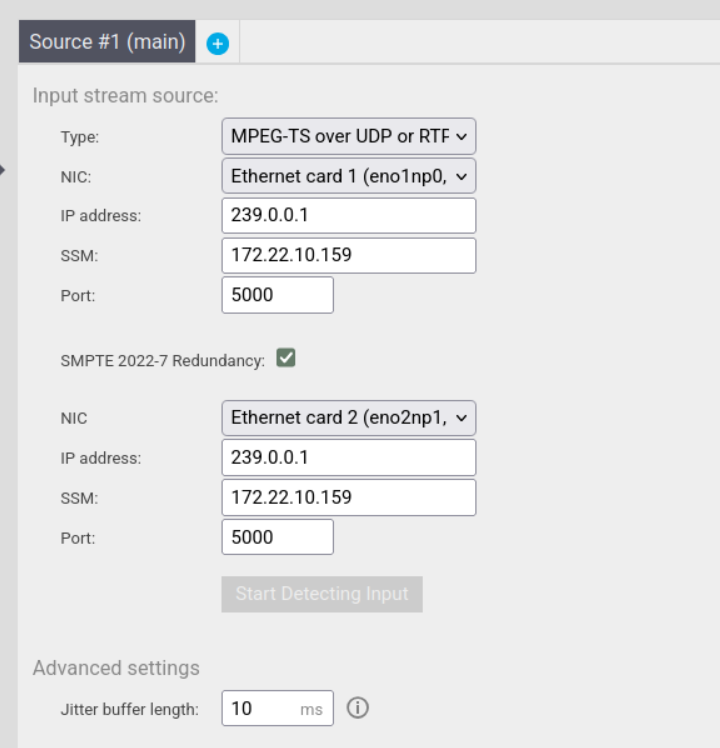
SMPTE 2022-7 input
Using RTP, it's possible to configure redundant input paths (SMPTE 2022-7) to avoid potential data loss on unreliable networks or long-distance content transfers. To configure redundant paths, enable the SMPTE 2022-7 Redundancy checkbox and fill in the specific NIC, IP address, SSM (Source-Specific Multicast), and ports for both the primary and redundant paths. The primary path is always preferred in the event of a data mismatch between the paths.
Based on your network environment, you can configure the Jitter buffer length (expressed as a skew or difference between both paths in ms). This value should account for the maximum expected jitter packets from both paths might experience, including a safety headroom. The default value is 10 ms, which is sufficient for LAN and inter-facility links. For long-haul links or environments with higher relative delay, values up to approximately 100 ms may be used. The allowed range is 1 to 400 ms. Increasing this value improves tolerance to delay variation but increases overall processing latency.
See Figure 28.